The Truth About the Seagate Exos Mozaic M 30Tb Hard Drive: Pros, Cons, and Verdict
Introduction
The Seagate Exos Mozaic M 30Tb hard drive represents another step in the industry’s push toward ever-higher-capacity spinning media. Targeted primarily at data centers, cloud providers, and professionals who need dense, cost-effective bulk storage, it promises to lower the cost per terabyte while packing more raw capacity into the familiar 3.5-inch form factor. For buyers who are deciding whether to deploy a 30TB drive in a server, NAS, or archive array, the key questions are: how does it perform in real-world workloads, what trade-offs were made to reach 30TB, and where does it belong in a modern storage strategy?
Product Overview and Context
What the Exos Mozaic M 30Tb is designed for
The Exos Mozaic M 30Tb is an enterprise/nearline hard disk drive (HDD) intended for dense storage applications. This class of drives prioritizes capacity, power efficiency per terabyte, and total cost of ownership (TCO) over low-latency random I/O. Common deployment scenarios include cold or warm object storage, backup repositories, media archives, and large-scale sequential datasets used by scientific computing and analytics.
Fundamental design trade-offs
To reach 30TB in a single drive, manufacturers typically use the latest high-density recording technologies and mechanical packaging techniques such as helium sealing, multi-platter assemblies, and higher track density. These choices increase areal density and lower power per TB, but they can affect random I/O latency and write behavior. Buyers should expect excellent sequential throughput and capacity efficiency, while being mindful of the limitations that come with ultra-high-capacity HDDs in random-write-heavy environments.
Detailed Review and Analysis
Performance characteristics
In practice, the Exos Mozaic M 30Tb will excel at sequential read and write workloads—large backups, media streaming, and bulk ingest pipelines. For these tasks, the drive’s throughput per platter and sustained transfer rates are competitive with other enterprise nearline models. Random IOPS, however, remain constrained by the mechanical nature of HDDs; therefore, latency-sensitive databases and small-block random-write workloads will not be the drive’s sweet spot.
Deployments that pair these drives with flash caching layers—SSDs used as write buffers or read caches—can hide the random I/O limitations while still benefiting from the low cost per TB of the Mozaic M. Systems using object stores (S3-compatible) or tape replacement strategies typically see the best return on investment.
Capacity and density
A single 30TB drive reduces rack space and cabling complexity compared to equivalent capacity built from smaller drives. For example, replacing multiple 8–12TB drives with a 30TB unit reduces drive bay consumption and simplifies RAID group layouts. This density is a major advantage for hyperscalers and enterprises where rack space and power are constrained.
Reliability, durability, and endurance
Enterprise-class drives like the Exos family emphasize durability. Expect features such as enhanced vibration tolerance, firmware optimized for RAID environments, and error recovery policies tuned for data center use. That said, higher-capacity drives can have different failure modes simply because there is more media and more mechanical complexity per drive. Administrators should continue to design redundancy (RAID/erasure coding), monitoring, and replacement strategies around the expectation that individual drive failures will occur.
Buyers should verify the warranty and Seagate’s recommended workload rating for the specific Mozaic M model before deployment. Enterprise warranties and specified annual workload (e.g., TB/year of writes) matter when planning for heavy write cycles.
Power, thermal, and acoustics
High-capacity drives are engineered for low watts-per-terabyte, which makes them attractive for large arrays. Helium-filled enclosures and careful head/platter engineering reduce friction and improve efficiency. However, thermal design remains important—dense arrays of 30TB drives will produce heat that must be managed with adequate airflow and cooling. Noise levels are typical of enterprise 3.5-inch HDDs; they are quieter than consumer desktop high-RPM drives in idle but may be noticeable when many drives spin under load. In a data-center rack, acoustics are rarely a primary concern, but in a home lab or small office NAS, it’s worth testing.
Discover deals on Laptops & Computers — updated daily.
View Offers →Firmware, features, and manageability
Expect enterprise firmware features: TLER-like error handling optimized for RAID, power management modes for scale-out environments, and robust SMART telemetry. Integration with chassis-level monitoring (e.g., SAS expanders, enterprise NAS) is standard. Administrators should confirm compatibility if they plan to use the drives in consumer-grade NAS enclosures—some appliances expect lower-capacity or desktop-class drives and may behave differently when presented with very high-capacity enterprise media.
Cost considerations
The main selling point is cost per terabyte. While the per-unit price of a 30TB drive is significant, the cost per TB can be substantially lower than smaller drives, especially once rack, power, and management costs are considered. For organizations optimizing TCO, the arithmetic often favors larger drives—so long as the workload aligns with the drive’s strengths.
Pros & Cons
- Pros:
- Very high capacity in a single 3.5-inch drive—reduces chassis and rack footprint.
- Competitive cost per terabyte for archival and bulk storage.
- Designed for enterprise workloads—RAID-friendly firmware and vibration tolerance.
- Lower power consumption per TB compared with smaller high-RPM disks.
- Excellent sequential throughput for backups, media, and large-file storage.
- Cons:
- Limited random I/O performance relative to SSDs and lower-capacity HDDs—unsuitable as primary storage for high-transaction databases.
- Higher impact when failures occur—greater rebuild times and potential rebuild stress on arrays.
- Potential compatibility issues with older or consumer-grade NAS enclosures.
- Thermal and vibration management become more important in dense deployments.
- Specifics like warranty length and workload rating should be checked; assumptions may lead to unexpected costs.
Side-by-side comparison
The following table compares the Exos Mozaic M 30Tb conceptually against common alternatives in the dense storage space. This table focuses on attributes buyers care about rather than exact model numbers, since exact specs can change between firmware revisions and sub-models.
| Drive | Typical Capacity | Best For | Typical Interface | Notes |
|---|---|---|---|---|
1. Workload alignmentDetermine the mix of sequential vs random I/O, read-to-write ratio, and block sizes. If the workload is predominantly sequential (large backups, media), the drive is likely a good fit. For random-heavy workloads, consider SSDs or smaller enterprise HDDs combined with caching. 2. RAID and rebuild strategyAsk how many drives per RAID group will be used, and calculate rebuild times. Larger drives take longer to rebuild; longer rebuilds increase exposure to additional failures. To mitigate risk, use erasure coding or RAID with appropriate redundancy and automated monitoring. 3. Controller and enclosure compatibilityVerify that the chosen server, HBA, or NAS supports drives of this capacity and that firmware can properly handle SMART reporting and error recovery. Some legacy controllers have limits on supported drive sizes or expect specific firmware behaviors. 4. Power and coolingCheck the Watts-per-drive and the cumulative effect on rack power and cooling. Ensure chassis airflow is sufficient and that the environment maintains recommended operating temperatures for enterprise drives. Find top-rated Laptops & Computers products at great prices. See Deals →5. Warranty and service-levelsConfirm warranty length, on-site replacement options, and workload rating (TB/year). For critical environments, extended support contracts and hot-spare strategies are worth considering. 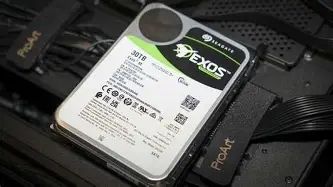 6. Firmware features and telemetryLook for enterprise-relevant features: TLER-style error handling, vibration compensation, and robust SMART attributes. Good telemetry enables predictive failure analysis and smoother maintenance. 7. Cost-per-TB and total cost of ownershipCompare the drive’s price-per-TB against alternatives, but include indirect costs: rack space, cooling, power, replacement spares, and administrative overhead. Sometimes a slightly higher-cost drive with a better warranty or lower failure rate reduces long-term expenses. 8. Future migration and scalingConsider how the storage design will evolve. If future growth is planned, higher-capacity drives reduce the number of migrations but increase rebuild complexity. Plan for data mobility and consider software-defined storage solutions that ease hardware changes. Maintenance, monitoring, and operational tips
ConclusionThe Seagate Exos Mozaic M 30Tb hard drive is a compelling option for organizations that need maximum capacity per bay and low cost per terabyte for sequential and archival workloads. Its strengths—density, energy efficiency per TB, and enterprise-oriented firmware—make it a logical choice for object storage, backup repositories, and cold-data tiers. However, the drive is not a one-size-fits-all solution. Random I/O performance, longer rebuild times, and the need for careful thermal and vibration management mean it is less appropriate for latency-sensitive production tiers and write-heavy small-block workloads. In short, the Exos Mozaic M 30Tb is best used where capacity and TCO matter most and where architecture includes redundancy, caching, or tiering to address the mechanical limitations of spinning media. Buyers should align workload expectations, verify compatibility with their controllers and enclosures, and plan redundancy and monitoring to take full advantage of what these ultra-high-capacity drives offer. When deployed thoughtfully, a 30TB enterprise nearline drive can simplify infrastructure and substantially reduce storage costs for the right use cases. Ready to Buy? Check Laptops & Computers on AmazonSee current prices, reviews, and deals from trusted sellers. See Deals on Amazon →
As an Amazon Associate I earn from qualifying purchases.
|