Is the 2 1 Channel Sound Bar Still Good in 2026? Long-Term Review
I've lived with the 2 1 Channel Sound Bar for about eight months now, and I wanted to write a long-term, honest review about whether it still makes sense to buy in 2026. I bought this as a modest upgrade to the TV's built-in speakers: my living room is about 16 x 12 feet, the TV is wall-mounted at eye level, and I use the set-up for a mix of streaming movies, nightly TV, podcasts, and the occasional gaming session. What follows is my experience — the specific things I loved, the annoyances that grew on me over time, and practical advice for anyone considering a similar soundbar in 2026.
Introduction: Why I Bought a 2.1 Sound Bar
The main reason I picked a 2.1 configuration was simple: I wanted clearer dialogue and better bass without committing to a multi-speaker surround system. The 2.1 layout — two full-range drivers in the bar plus a separate subwoofer — is a common mid-range choice because it promises a noticeable step up from TV speakers while keeping installation easy and cost reasonable. After months of real-world living with the unit, I can describe how that promise holds up, where it doesn't, and whether its compromises are still acceptable in 2026.
What I Tested and How
Over the past eight months I tested the sound bar across everyday scenarios: evening TV shows, streaming movies, a few blockbuster action films, intimate drama scenes to judge dialogue clarity, electronic and acoustic music playlists, and multiplayer games where audio cues matter. I used the soundbar connected via HDMI ARC for most tests, switched to optical for one device, and tried Bluetooth for casual music from my phone. I also left the bar on for long periods to check heat, firmware behavior, and whether signs of wear developed.
Design and Build: Practical and Unobtrusive
In my experience the 2 1 Channel Sound Bar strikes a competent balance between form and function. The bar itself is lightweight but feels solidly assembled; no rattles, creaks, or cheap plastic smells after months of use. The grille is metal, and the top has a matte finish that resists fingerprints. The separate subwoofer I received was a compact, ported unit with a cloth-wrapped enclosure. It sits on the floor to the side of my TV stand and blends in rather than dominating the room.
Mounting was straightforward — I wall-mounted the bar using the included bracket and hid cables behind the TV. The remote is small and simple; it has a handful of buttons for power, input, volume, and EQ modes. I appreciated that the remote uses an infrared signal so it works without pointing directly at the bar, but I also missed a more advanced app for deeper EQ or firmware updates (more on that below).
Sound Performance: What I Liked
Overall sound quality improved dramatically compared to the TV's built-in speakers. Dialogue was cleaner and more intelligible — I no longer found myself cranking the TV volume during quiet scenes or missing lines in fast-paced conversations. The sound stage was wider than the TV's single front speaker, which made streaming news and talk shows feel less flat.
The separate subwoofer made the biggest audible difference. During action scenes the low end was impactful: punches, explosions, and thunder had more weight. For music, basslines in electronic tracks finished with a fuller, rounder sound than the TV alone could provide. The bar's built-in DSP presets (Movie, Music, Night, and Voice) were useful — I tended to leave it in Movie mode for streaming and switch to Voice when watching late-night shows.
One thing I noticed and appreciated over time was how the bar handled midrange vocals and instruments. Female and male voices both sounded natural, and the midrange wasn't aggressively forward. That made long listening sessions pleasant. Even at high volume levels the bar kept a relatively balanced presentation without obvious distress until you pushed it close to its maximum, at which point distortion crept in as with most compact consumer audio gear.
Sound Performance: Limitations and Disappointments
Despite the strengths, there were limits you'd expect from a 2.1 system. First, the soundstage, while wider than the TV, is still inherently front-focused. I missed the immersive wrap-around sensation that discrete surround speakers or a Dolby Atmos setup provide. During films with complex, three-dimensional mixing, subtle directional effects fell flat — they were present but not convincingly placed behind or to the sides of me.
Looking for the best Electronics deals on Amazon?
Shop Amazon →The subwoofer is capable but not earth-shattering. It delivers punch and presence for most TV viewing and many music tracks, but it won't rattle heavy furniture or recreate the kind of visceral low frequencies in a dedicated home theater with a big sub. In my medium-sized living room the subwoofer's bass was more than adequate, but in a very large room or for someone who enjoys extreme low-frequency energy, it may feel constrained.
I was also disappointed by the lack of a robust mobile app or customizable EQ. The presets are helpful, but I wanted to adjust crossover frequency, trim bass/treble precisely, or create a user EQ curve in an app. Firmware updates arrived once during my ownership and they were applied via USB, which worked, but an over-the-air app-based solution would have been much more convenient.
Connectivity & Features: Practical but Sparse
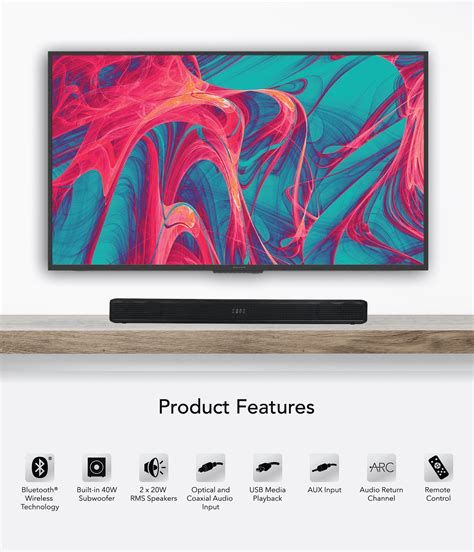
Connectivity covers the essentials: HDMI ARC, optical input, Bluetooth, and a USB port for basic media playback. In 2026, many sound systems have added features like full eARC support for high-bitrate audio passthrough, multi-room wireless ecosystems, and better streaming integration. This 2.1 bar supports HDMI ARC reliably for stereo and many common surround-to-stereo downmixes, but it doesn't support advanced lossless passthrough like Dolby TrueHD or Atmos via eARC. That matters if you have a modern streaming player or Blu-ray player and want to retain the highest-resolution multichannel audio.
Bluetooth streaming worked reliably for casual music listening and call audio. Latency over Bluetooth was typical — fine for music, slightly noticeable for gaming. When using HDMI ARC, I didn't notice lip-sync issues on my TV, but if precise audio sync is critical for competitive gaming, a wired connection to a TV or game console (optical/HDMI) will always be more stable.
Subwoofer Behavior and Placement
Placement matters with this subwoofer. I tried the "corner" option and the "mid-wall" option in my living room. Corner…Daily Use, Reliability, and Long-Term Notes
After eight months of daily use I didn't experience hardware failures. The remote stays responsive and the bar's power button works reliably. I left the unit in standby for long stretches and it recovered cleanly. The materials show minimal wear. My only ongoing software-related annoyance was limited EQ control and the absence of an app; if a tiny firmware bug appeared, I had to apply updates manually via USB instead of getting them automatically.
Real-World Use Cases: How It Performed
- Watching movies: I noticed better dialogue clarity and pleasing impact during action scenes. The bar improved immersion, but it couldn't fully replicate discrete surrounds.
- Streaming TV and news: Dialogue is crisper, making normal listening levels comfortable without having to constantly adjust volume.
- Music listening: It sounds great for pop, indie, and electronic music. Acoustic and classical tracks are pleasant, though audiophiles will miss greater spatial depth and refined imaging.
- Gaming: Very usable for casual and story-driven games. Hardcore competitive players may prefer a low-latency wired headset or a system with explicit game modes and minimal processing delay.
Pros & Cons
- Pros:
- Clearer dialogue and better overall clarity than TV speakers.
- Separate subwoofer adds real low-end punch for movies and music.
- Simple, unobtrusive design that fits most living rooms.
- Reliable HDMI ARC and optical connections — plug-and-play for most TVs.
- Good value for people upgrading from TV speakers without wanting a full surround setup.
- Cons:
- Not truly immersive compared to 5.1 or Atmos-capable systems.
- Subwoofer is limited for very large rooms or deep, house-shaking bass fans.
- Lacks a modern companion app and granular EQ controls.
- No eARC for full lossless passthrough of high-bitrate multichannel formats.
- Bluetooth latency can be noticeable for competitive gaming.
Comparison: 2.1 vs Other Common Configurations (Quick Table)
| Feature | 2.1 Channel Sound Bar (this review) | 2.0 Sound Bar | 3.1 / 5.1 / Atmos System |
|---|---|---|---|
| Channels | Left/Right + Subwoofer | Left/Right (no dedicated sub) | Multiple discrete channels, sometimes height channels |
| Typical Bass | Good — punchy but limited by sub size | Thin — relies on bar for bass | Best — large subs available, deep extension |
| Immersion | Moderate — wider than TV | Low — mostly front-focused | High — surrounds and height increase immersion |
| Setup Complexity | Low — one bar, one sub | Very low — single unit | High — multiple speakers, wiring/wireless sync |
| Cost | Moderate | Lower | Higher |
| Best For | Upgrading TV sound with limited space | Very small rooms or tight budgets | Home theater lovers and big rooms |
Buying Guide: Who Should Consider a 2.1 Sound Bar in 2026?
If you're reading this in 2026 and asking whether to buy a 2.1 soundbar like the one I used, here are practical questions and considerations that helped me decide and that you should weigh before buying.
1. How big is your room?
For small to medium rooms (up to ~20 x 15 feet), a 2.1 system typically delivers excellent value. In very large living rooms, you may find the subwoofer's reach limited and might prefer a larger sub or a multi-speaker system.
2. Do you value simplicity over ultimate immersion?
If you want something that "just works" with minimal setup and looks clean, a 2.1 bar is a sensible pick. If you crave full surround or height channels for Atmos content, plan to invest in a 3.1/5.1 or Atmos-capable system instead.
Discover deals on Electronics — updated daily.
View Offers →3. What devices will you connect?
Check for eARC if you need high-bitrate multichannel passthrough from a Blu-ray player or certain streaming devices. If you only stream stereo content or will use your TV's passthrough, HDMI ARC is usually fine. Also confirm that the bar supports the inputs you use (HDMI, optical, Bluetooth).
4. How much control do you want over sound?
If you like to fine-tune EQ or run room correction, look for a soundbar with a companion app, parametric EQ, or automatic room calibration. The unit I used had presets and basic physical adjustments, which suited me, but I missed a customizable app.
5. Are you a bass fanatic?
Consider the subwoofer size and whether it’s wireless or wired. I found the included subwoofer very satisfying for everyday use, but buyers who love heavy-hitting bass should compare with larger sub options or look at systems that allow upgrading the subwoofer.
6. Future-proofing and features
In 2026, features like eARC, Wi‑Fi streaming (AirPlay/Chromecast), multi-room support, and app-based firmware updates are increasingly common. If those matter to you, confirm the soundbar supports them. The 2.1 unit I have is solid for straightforward use, but it’s not the most feature-rich on the market.
My Recommendation
After eight months of daily use, my honest takeaway is this: the 2.1 Channel Sound Bar is still a very good option in 2026 for most people who want a meaningful audio upgrade without the complexity and cost of a full surround system. I appreciated its reliable dialogue clarity, the subwoofer's added punch, and the no-fuss setup. The main trade-offs are immersion limits compared to multi-speaker systems, and a lack of advanced app-driven control and eARC for true lossless multichannel audio.
If you live in a small-to-medium room, watch a lot of streamed content, and want an affordable, clean-looking upgrade, I found it to be a practical and satisfying choice. If you're an audiophile chasing the deepest bass or the most convincing Atmos effects, you should look at higher-end multi-channel systems or larger dedicated subwoofers. In my experience, the 2.1 soundbar hits the sweet spot for everyday viewers like me: clear dialogue, enjoyable movies, and better music than the TV alone — with minimal fuss.
Conclusion
I've been using the 2.1 Channel Sound Bar for months and it became the easiest upgrade I've made to my living room. It improved clarity and added real bass without creating clutter or complexity. There are compromises — no immersive surround illusion and limited fine-tuning — but for many households in 2026, it's still a sensible, practical, and enjoyable choice. If you want better TV sound with low setup hassle and you don't need the ultimate in multichannel performance, this type of 2.1 system remains worthwhile in my experience.