Don't Buy Until You Read This: 8849 Tank 4 Pro Rugged Phone vs Gmktec Nucbox M3 Ultra Mini Pc
Introduction
Choosing between two very different devices can be confusing: on one hand, a purpose-built rugged smartphone promising survivability in harsh environments; on the other, a compact mini PC designed to bring desktop-class capability into a tiny chassis. This article compares the 8849 Tank 4 Pro Rugged Phone and the Gmktec Nucbox M3 Ultra Mini PC across real-world use cases, durability, performance, connectivity, and value. Rather than listing isolated specs, the goal is to explain what each device actually delivers to typical buyers — field workers, outdoor enthusiasts, small-business owners, remote workers, and home media buffs — and to help readers make a practical purchasing decision.
Who should read this
- People who need a hardened mobile communications device for work outdoors or in industrial settings.
- Users who want a tiny, energy-efficient desktop or media PC for home offices, living rooms, or as an edge server.
- Anyone weighing durability and portability against everyday performance and expandability.
8849 Tank 4 Pro Rugged Phone — Detailed review and analysis
Design and durability
The 8849 Tank 4 Pro is built around a survival-first philosophy. Its chassis uses thick protective bezels, reinforced corners, and tactile physical buttons that are easier to operate with gloves or when wet. The device emphasizes IP-class dust and water resistance and mechanical shock protection — traits buyers expect from "rugged" phones. The exterior design favors function over aesthetics: expect a larger, heavier device than a consumer handset, with rubberized surfaces and a screen recessed behind raised bezels to reduce impact damage.
Display and usability
Rugged phones often trade display elegance for toughness. The Tank 4 Pro typically has a display tuned for outdoor visibility, with higher contrast and touch sensitivity settings that work with gloves or in damp conditions. The touchscreen responsiveness may be slightly less refined than flagship consumer phones, but physical programmable buttons and dedicated utility keys can compensate in scenarios where quick access to tools — torch, push-to-talk, SOS — matters.
Performance and software
Performance on rugged phones is usually balanced toward reliability and battery conservation rather than raw speed. The Tank 4 Pro is best understood as a work device: it should run common Android apps, navigation, and field-specific software smoothly, but buyers expecting flagship-level gaming performance should temper expectations. A critical buying consideration is software support: long-term Android updates are less common on niche rugged brands, so confirm update policies before buying.
Battery life and power features
Battery capacity and efficiency are central to the appeal of rugged phones. The Tank 4 Pro emphasizes all-day operation in the field and may include large capacity batteries, power-saving modes, and reversible charging features for emergency use. For users in remote locations, the ability to recharge via USB-C PD, car adapters, or solar chargers can be decisive.
Connectivity and extras
Rugged phones target connectivity diversity: dual-SIM options, robust LTE support, GPS/GLONASS/Beidou for reliable positioning, and sometimes dedicated radios such as walkie-talkie or NFC for contactless tools. Buyers should verify cellular band support for their region, as international compatibility can vary.
Real-world use cases
- Construction and site managers who need a phone that endures drops, dust, and water, while providing maps, messaging, and quick data capture.
- Adventure travelers and guides who require reliable GPS, long battery life, and a device that tolerates rain and rough handling.
- Industrial technicians who use purpose-built apps and require programmable physical buttons to trigger workflows safely while wearing PPE.
Pros & Cons
- Pros: Durable build engineered for harsh environments; long battery life and power features geared toward remote use; tactile buttons and outdoor-readable display; focused connectivity for field work.
- Cons: Larger, heavier, and less pocket-friendly than mainstream phones; likely slower CPU/GPU performance compared with consumer flagships; software updates and long-term support can be limited.
Gmktec Nucbox M3 Ultra Mini PC — Detailed review and analysis
Design and build
The Gmktec Nucbox M3 Ultra is a tiny desktop replacement aimed at spaces where a traditional tower would be overkill. The enclosure is compact and usually cooled via a small fan or passive solution depending on the configuration. The build focuses on practical cooling, stable I/O, and minimizing desk footprint. Its industrial aesthetic means it integrates well into home-theater setups, small offices, and kiosks.
Performance and everyday use
Mini PCs like the Nucbox M3 Ultra are marketed for balanced performance: faster than Raspberry Pi-class devices yet far smaller than conventional desktops. They are commonly offered with laptop-class processors that provide adequate multi-tasking for productivity apps, web browsing, streaming, and light content creation. For heavier workloads — prolonged rendering, serious video editing, or high-end gaming — a full-sized desktop will still be preferable. Where the Nucbox shines is in providing consistent, quiet performance for common desktop tasks and 4K media playback in a small, energy-efficient package.
Discover deals on Laptops & Computers — updated daily.
See Deals →
Ports, expandability, and storage
Port selection is a key differentiator for mini PCs. The Nucbox M3 Ultra typically includes multiple USB ports, HDMI and/or DisplayPort out, gigabit Ethernet, and audio jacks, making it flexible for monitors, external drives, and peripherals. Many mini PCs also provide M.2 slots for NVMe storage and SODIMM slots for RAM expansion, though soldered RAM or limited internal space can restrict upgrade paths. Buyers who expect to expand storage or RAM should confirm the specific model’s upgradeability before purchase.
Thermals and noise
Because of the small enclosure, thermal performance matters. Well-designed units maintain steady performance under sustained loads without throttling or creating distracting fan noise. If the Nucbox M3 Ultra uses active cooling, the fan curve and ventilation become important — quieter fans and better airflow are preferable for living-room or bedroom use. For always-on roles like a home server, passive or low-speed active cooling with stable thermals is ideal.
Real-world use cases
- Remote workers and students who need a compact desk PC for documents, spreadsheets, and video conferencing.
- Media center users wanting a small living-room box for streaming, local 4K playback, and light emulation.
- Small business owners or hobbyists running lightweight servers, network appliances, or developers needing a small test machine.
Pros & Cons
- Pros: Small footprint saves desk space; generally good performance for office tasks and media; multiple ports and connectivity options; low power consumption.
- Cons: Limited upgradeability in some SKUs; not intended for sustained heavy CPU/GPU workloads; thermal constraints can influence long-term performance.
Side-by-side comparison
| Category | 8849 Tank 4 Pro Rugged Phone | Gmktec Nucbox M3 Ultra Mini PC |
|---|---|---|
| Primary purpose | Durable mobile communication, field tools, navigation | Compact desktop computing, media playback, small servers |
| Portability | High — pocketable but bulkier than regular phones | High for a PC — fits in a bag or behind a monitor, not pocketable |
| Durability | Engineered for drops, dust, and water resistance | Standard consumer durability; not designed for rough handling |
| Performance | Optimized for reliability and power efficiency; adequate for apps and navigation | Closer to laptop/desktop class for everyday productivity and media |
| Battery / Power | Internal battery for hours/days of operation; supports mobile charging | Requires external power; low idle power consumption |
| Connectivity | Cellular, GPS, Wi-Fi, Bluetooth; some models include NFC or dedicated radios | Ethernet, multiple USB, video out(s), Wi-Fi, Bluetooth |
| Upgradeability | Limited — mostly fixed hardware except for storage in some models | Moderate — potential NVMe/RAM upgrades depending on SKU |
| Best for | Field workers, adventurers, industrial use | Home office, HTPC, small network services |
Buying guide — how to pick between them
1. Start with the use case
Decide what problem the device is meant to solve. If mobility in harsh conditions with cellular connectivity and long battery life is required, the rugged phone is the obvious choice. If the need is a small, low-power desktop for work, streaming, or always-on services, the mini PC delivers more compute and expandability.
2. Consider environment and durability
For outdoor or industrial contexts, prioritize ingress protection (IP) and drop resistance. Look for devices wit…3. Evaluate performance needs realistically
Match processor class to tasks. Spreadsheets, email, and video calls are lightweight; any modern mini PC or mid-range rugged phone SoC can handle them. Creative tasks, virtualization, or gaming require a higher-tier mini PC or a dedicated desktop with a powerful GPU.
4. Check connectivity and compatibility
For phones, confirm cellular bands and satellite/GPS performance for the buyer’s region and carrier. For mini PCs, look for the right mix of video outputs, USB ports, and Ethernet support. If the plan involves multiple monitors, check display outputs and maximum supported resolutions.
5. Upgradeability and long-term cost
Mini PCs often offer better upgrade paths for storage and memory, which can extend useful life. Rugged phones trade upgradeability for sealed protection; however, the higher initial robustness can reduce replacement frequency. Factor in warranty, spare parts availability, and repairability.
Looking for the best Laptops & Computers deals on Amazon?
Shop Amazon →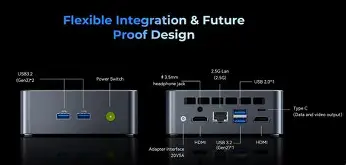
6. Power and battery concerns
For the phone, battery endurance, charging speed, and support for external charging solutions are essential. For the mini PC, power delivery (USB-C PD support), adapter efficiency, and sleep/idle power draw will impact electricity costs and placement options.
7. Software, updates, and ecosystem
Verify the manufacturer’s track record on software updates and security patches. Rugged phones used in business contexts benefit from predictable update cycles. Mini PCs based on mainstream chipsets typically run standard operating systems (Windows, Linux) with broad software compatibility — an advantage in corporate settings.
8. Noise and thermal considerations
If the mini PC will live in a living room or bedroom, fan noise can be a deal-breaker. Check independent reviews for noise measurements and thermal throttling behavior under sustained load.
9. Price versus value
Compare total value rather than headline price. A rugged phone saves costs by reducing replacements in demanding environments; a mini PC reduces the need for a bulky desktop and can lower power bills. Consider accessories (cases, mounts, power adapters) commonly required for each device.
Practical purchase checklist
- Purpose: What primary tasks will the device perform?
- Durability: Does the device meet the environmental standards needed for its use?
- Connectivity: Are the cellular bands, Ethernet speeds, or video outputs compatible with current equipment?
- Battery/Power: For the phone, how long does a charge last in real usage? For the mini PC, what is the adapter wattage and idle consumption?
- Support: Manufacturer warranty length and availability of spare parts or service centers.
- Upgrade path: Can RAM or storage be increased later, and how easy is the process?
Conclusion
The choice between the 8849 Tank 4 Pro Rugged Phone and the Gmktec Nucbox M3 Ultra Mini PC depends almost entirely on intended use. The Tank 4 Pro is a purpose-built tool for people who spend long hours in the field, need robust physical protection, reliable cellular connectivity, and extended battery life. The Nucbox M3 Ultra is a small, practical desktop that trades mobility for greater compute, ports, and upgrade potential suitable for home offices, media centers, and light server roles.
For buyers whose days include mud, rain, or heavy equipment, durability and battery life will outweigh the lack of flagship performance. For users who need a compact, quiet workstation or media hub, the mini PC’s flexibility and desktop-like experience make more sense. Assess real-world needs — the environments in which the device will live, the specific applications to run, and expectations for updates and service — then choose the device that aligns with those priorities.